
One moment the feeder is full. The next, a long-tailed bird streaks past the fence and every sparrow vanishes. A few seconds later, the visitor lands in a nearby tree. You have just enough time to notice a hooked bill, a barred tail, and a very alert stare. Now what do you look at?
A Cooper’s Hawk and a Sharp-shinned Hawk can give you almost exactly that view. Both hunt birds, both can pass through a backyard, and both change appearance as they mature. Start with the shape of the head and body, then look at the tail. If the bird stays long enough, check the plumage and watch how it holds itself. A few details seen clearly will get you farther than trying to guess its size across the yard.
Start with the head and shoulders
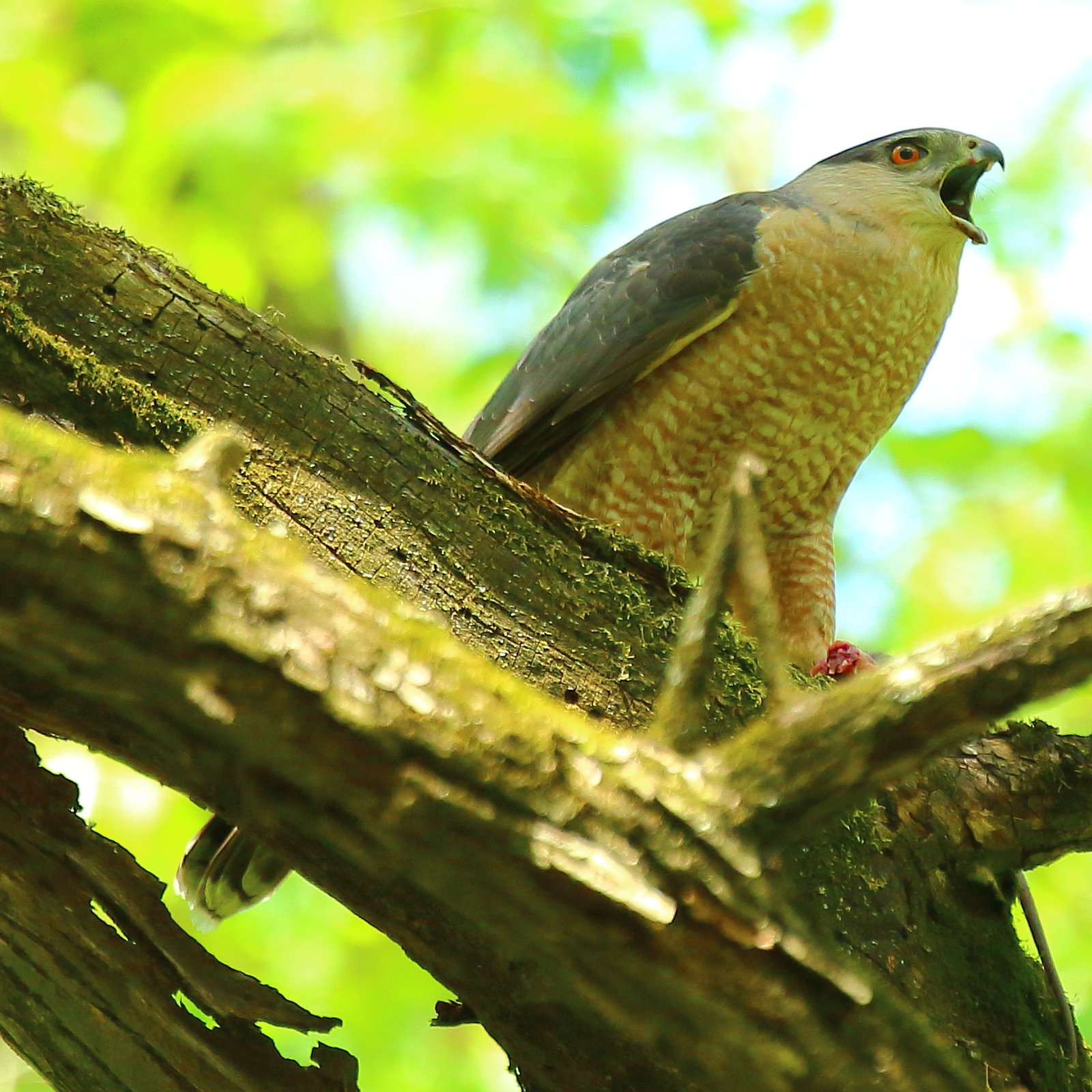
A Cooper’s Hawk tends to look long-bodied, with a comparatively large head and a neck you can sometimes see when it stretches forward. Look at the outline from the bill to the back of the head. The crown can appear a little angular, especially when the feathers rise at the back. From the side, the eye often looks fairly close to the bill.
A Sharp-shinned Hawk typically has a smaller, rounder head for its body. It may look as though its head sits right down between its shoulders. When the bird faces you, those shoulders can look broad above a narrower lower body. That tapered shape is easier to see when the hawk stands upright and relaxed. A crouching bird or one twisting to look behind itself can give a very different impression.
Give the bird a moment to turn. A hawk that looks small-headed while looking straight at you might show a stronger neck and a longer head in profile. If all you saw was a silhouette against a bright sky, make a mental note of the shape and leave the finer details for a better view.
Read the tail when you can see the feathers

The Cooper’s usually has shorter outer tail feathers and longer central ones. When you can see them together, the tip often looks rounded or graduated. A Sharp-shinned Hawk often shows tail feathers that end at roughly the same level, giving the tip squarer corners. A pale terminal edge is often more noticeable on the Cooper’s, though wear, lighting, and individual variation can change how obvious it looks.
The angle matters. A Cooper’s perched with its tail tightly folded can hide the shorter feathers and look square from behind. A Sharp-shinned Hawk can look rounded when it spreads its tail. A single picture taken at the moment of landing can capture an especially misleading shape. Wait for the bird to settle or turn, and look for differences in feather length instead of relying on the outline alone.
A good side view of the head and a clear look at the tail make a useful pair. If the head says Cooper’s and the tail seems square, ask whether you really saw the tail feathers separately. A better angle may explain the difference. If the clues still disagree, keep the identification open.
Check whether you are looking at an adult or a juvenile

Adults of both species can show gray upperparts and warm, horizontal barring across a pale breast. Adult Cooper’s Hawks often show a darker cap above a distinctly lighter nape. On an adult Sharp-shinned Hawk, the dark crown often continues farther down the back of the neck, giving the head a more hooded look. That comparison works best when the bird turns partly away in good light. A shadow across the neck can hide the transition.
Young birds of both species are brown above and streaked below. Young Cooper’s Hawks often show relatively fine, crisp streaks that are strongest on the upper breast. A young Sharp-shinned may show heavier or less sharply defined marks that extend farther down. The pattern varies, so use the streaking as supporting evidence. A pale nape on a brown young bird carries much less weight than it does on an adult.
Eye color changes as hawks mature and varies with age and individual. It can be striking through binoculars, but it is a poor shortcut between these two species. The same goes for the reddish breast of an adult or the brown back of a juvenile. Those colors tell you where to begin your comparison.
Size helps when you have something to compare

A Cooper’s Hawk is larger on average. The difficulty is that females are larger than males in both species, and a large female Sharp-shinned can approach a small male Cooper’s in size. Distance makes the comparison even harder. A small hawk near the window can look much bigger than a larger one across the yard.
If it lands on a familiar fence post, feeder pole, or railing, you have a reference you can use. Note the part of the post it occupied and how it stood. A hawk stretched upright with feathers pressed tight can look quite different from the same bird crouched and fluffed up. With a clear view, a Sharp-shinned Hawk’s very thin lower legs can also help support the identification.
A bird that passes overhead may show another difference. A Cooper’s often projects more head and neck in front of the wings, while the Sharp-shinned can look small-headed in flight. Wing position and viewing angle change that silhouette from moment to moment. If you see only a blur between two shrubs, the best observation may be simply “small, long-tailed hawk.”
Make the most of a ten-second look
If the hawk is perched, spend the first few seconds on the head. Is there a distinct neck, and where does the eye sit in profile? Next look at the tail and see whether you can make out individual feather tips. Use the last moment to check the chest and legs. If the bird is flying away, reverse the order: take in the whole silhouette and head projection while you still can.
On a gray day, the outline may tell you more than color. On a bright day, a pale nape may be easier to judge after the hawk turns out of direct sun. If a branch hides the tail, stay with the head and body clues you can see. You can always compare those with a later sighting.
What to do when a hawk visits your feeder
Watch from indoors or another quiet spot and give the hawk room. A visit is part of ordinary predator behavior. The smaller birds may hide in shrubs, go still, or leave the feeding area for a while. A quiet feeder by itself cannot tell you what happened. Our guide to why birds stop coming to a feeder walks through other reasons to check when the lull lasts longer than a quick visit.
If a hawk repeatedly hunts at the same feeder and you prefer to interrupt that pattern, Cornell’s Project FeederWatch handbook suggests bringing feeders in for a few days. Before putting them back, look at where your regular visitors go when they scatter. Can they reach protective shrubs quickly? Do cats have a hiding place right next to the feeder? A small adjustment can make the route to cover better while reducing ambush opportunities at the feeding spot. Keep any change compatible with your winter feeder and window-safety setup.
There’s no need to go outside to move a perched hawk along. If it settles nearby, this may be your best chance to see the details that disappeared in flight. Watch where it goes when it leaves. The next visit may be easier to follow once you know which fence line or tree it uses.
Keep notes you can use later
For a brief sighting, write down two or three things you actually saw. “Brown back, vertical chest streaks, large head in profile” is a stronger record than a species name based on a hunch. If you can take a photo through the window, try to include the entire bird and tail. A second frame from the same spot as the hawk turns can show details the first one hid.
When you get a longer look, compare the photos and notes with Cornell’s side-by-side hawk comparison and Audubon’s Sharp-shinned Hawk guide. Project FeederWatch accepts “Sharp-shinned/Cooper’s Hawk” when a participant can narrow an observation to those two species. Leaving a record at that level keeps the useful details while giving the next sighting a chance to fill in the rest.


0 Comments