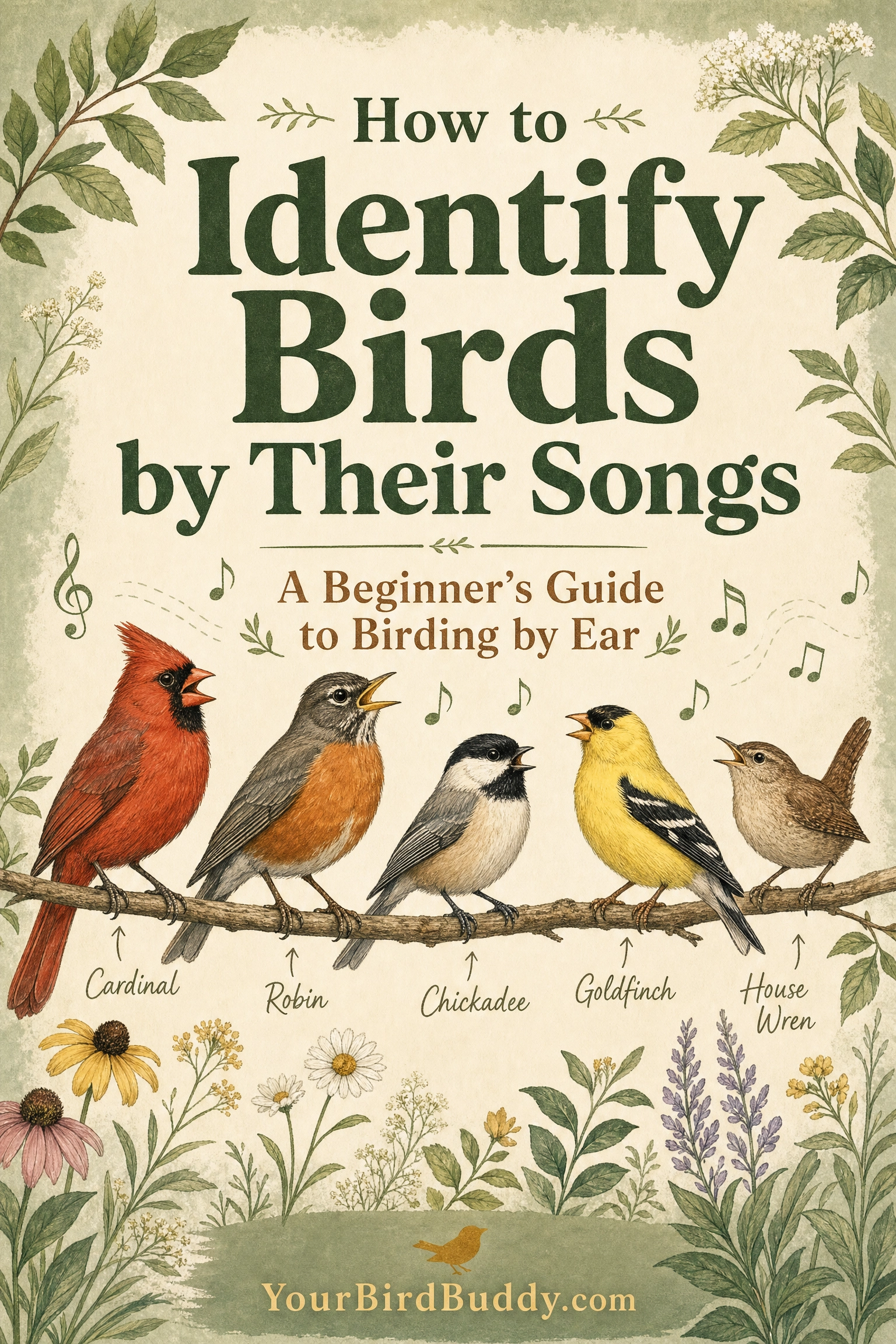
You hear it every morning — a cheerful, rolling melody drifting through your backyard. But which bird is it? Learning to identify birds by their songs opens up an entirely new dimension of birdwatching, one you can enjoy even without binoculars.
Birding by ear is a skill that takes time to develop, but once you start, you’ll be amazed at how much bird activity you were missing. This guide will give you the tools, tips, and tricks to start recognizing your backyard birds by sound — even as a complete beginner.
Why Learn to Bird by Ear?
Most birders rely almost entirely on sight, but the truth is that you’ll hear far more birds than you’ll ever see. Birds are often hidden in dense foliage, singing from the treetops, or moving quickly through brush. Their songs, however, carry clearly through the air.
Learning bird songs also helps you detect birds you’d otherwise miss entirely, identify species at night or in poor visibility, locate birds more quickly by following their calls, and deepen your appreciation for the birds already in your yard.
Understanding the Difference: Songs vs. Calls
Love Birds? Shop Our Etsy Store!
Faith-filled bird shirts, mugs & gifts — beautifully printed & shipped fast. 122+ designs, 5-star rated.
🛒 Shop YourBirdBuddyShop on EtsySongs are typically longer, more complex, and melodic. They’re used primarily by males to establish territory and attract mates. Most birdsong happens in the early morning hours — the famous “dawn chorus.”
Calls are shorter, simpler vocalizations used for communication — alarm calls, contact calls between flock members, or begging calls from young birds. Both males and females make calls year-round.
10 Common Backyard Birds and Their Songs
1. Northern Cardinal
The sound: A loud, clear whistle — often described as “cheer-cheer-cheer” or “birdy-birdy-birdy.” One of the most recognizable backyard songs in North America.
Memory trick: Imagine a cheerful person calling out “PRETTY-pretty-pretty!”
2. American Robin
The sound: A rich, rolling carol — “cheerily, cheer up, cheer up, cheerily, cheer up.” Often one of the first songs you hear in the morning.
Memory trick: It sounds like a cheerful conversation — up and down, back and forth.
3. Black-capped Chickadee
The sound: The classic “chick-a-dee-dee-dee” call is unmistakable. Their song is a clear, whistled “fee-bee” or “fee-bee-ee.”
Memory trick: They literally say their own name.
4. American Goldfinch
The sound: A bright, bouncy “po-ta-to-chip” call in flight. Their song is a long, canary-like series of twitters and trills.
Memory trick: Listen for “potato chip” every time one flies over.
5. White-breasted Nuthatch
The sound: A nasal, rapid “yank-yank-yank” — almost like a tiny toy horn.
Memory trick: It sounds like someone honking a small bicycle horn repeatedly.
6. Mourning Dove
The sound: A soft, mournful “coo-OO-oo-oo-oo” — slow and gentle, often mistaken for an owl by beginners.
Memory trick: It sounds genuinely sad, like someone sighing deeply.
7. House Wren
The sound: An incredibly loud, bubbling, cascading song for such a tiny bird — a rapid series of trills and chatters that tumbles over itself.
Memory trick: It sounds like a tiny machine gun of musical notes.
8. Tufted Titmouse
The sound: A loud, clear “peter-peter-peter” whistle, repeated insistently.
Memory trick: It’s literally saying a name — “PETER! PETER! PETER!”
9. Downy Woodpecker
The sound: A high, descending whinny — “pik-pik-pik” and a rattling call that drops in pitch at the end.
Memory trick: Think of a horse whinnying, but much smaller and higher-pitched.
10. Song Sparrow
The sound: Starts with 2–3 clear notes, then launches into a complex trill — “maids-maids-maids, put-on-your-tea-kettle-ettle-ettle.”
Memory trick: The “tea kettle” mnemonic is a classic birder’s trick.
5 Tips for Learning Bird Songs Faster
1. Start With Your Most Common Birds
Don’t try to learn 50 songs at once. Pick the 5–10 birds you see most often in your yard and focus on those first. Once those are solid, add more.
2. Use the Merlin Bird ID App
The free Merlin Bird ID app by Cornell Lab of Ornithology has a Sound ID feature that listens to birds in real time and identifies them instantly. It’s an incredible learning tool.
3. Listen at Dawn
The dawn chorus — the explosion of birdsong that happens in the hour before and after sunrise — is the best time to practice. Birds are most vocal and the air is usually quiet.
4. Repeat, Repeat, Repeat
The key to learning bird songs is repetition. Listen to recordings of target species on apps like Merlin or websites like All About Birds before you go outside, then try to match what you hear.
5. Create Memory Tricks
The best birders use mnemonics — phrases that sound like the bird’s song. Personal memory tricks tend to stick better than borrowed ones.
The Bottom Line
Learning to identify birds by ear is one of the most rewarding skills a birder can develop. Start small, be patient, and use the tools available to you. Before long, you’ll be waking up every morning to a symphony you can actually understand — and your backyard will never feel the same.
Love birds as much as we do? Explore our collection of bird lover shirts, mugs, and gifts — made for the birder who finds joy in every song.
Related Posts
- 10 Proven Tips to Attract More Birds to Your Backyard This Season
- 7 Bird Feeding Mistakes You’re Probably Making
- The Incredible Journey: Everything You Need to Know About Hummingbird Migration
Enjoyed this post? Browse our Etsy shop!
Bird shirts, mugs & faith apparel · 122+ designs · ★★★★★ 5.0

0 Comments